
Table of Contents
Wild Solomon’s Seal Dawn in the Qinling Mountains
My name is Zhang Li. I am 38 years old. I am the fifth generation of my family to dig roots from these unforgiving cliffs.Wild Solomon’s Seal
My grandfather’s voice still echoes in my bones. I was eleven when he knocked his pipe against the stone doorstep and looked me in the eye: “The mountain grass can save a life. The mountain itself can take one just as fast.” That same year, the handle of the hoe tore my first blood blister. I have never put it down.
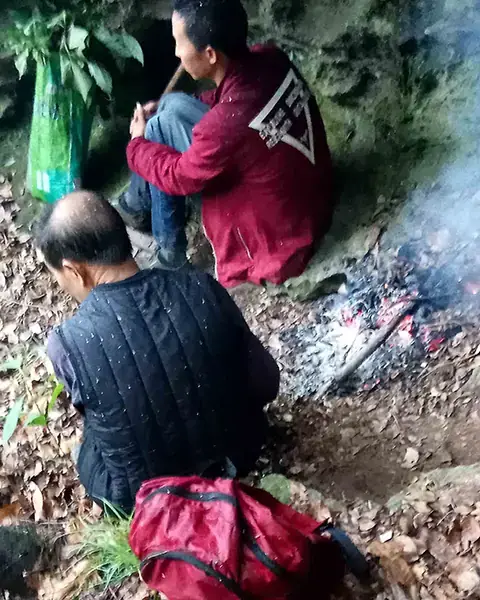
The northern face of Turtle Mountain is called Red Cloud Cliff. In the morning mist, the exposed iron-rich rock glows like the raw entrails of a disemboweled beast. To find the finest Huangjing (Solomon’s Seal), you must go where the soil has never been tilled—vertical ground.
The rope bites into my shoulder blades. Old Geng is above me, anchored like a gecko in a crevice. He has been doing this for twenty years. His rule is simple: “Your life is your own. Your money is your own. Getting crushed to paste is better than starving to death.”Wild Solomon’s Seal
I hang 200 meters above the void, wind whistling past my ears. My fingers brush aside thick, waxy leaves. There it is—the root. Unlike the flamboyant ginseng, Huangjing is a hermit. Its brown, knobby body hides a sweetness that city dwellers pay fortunes for, believing it to be the “food of immortals.”
I wedge the hoe into the crevice. The root grips the rock like a dragon’s claw. Every pry must be surgical—enough to loosen the earth, but not so rough as to snap the prized rhizome.
“See that big one?” Old Geng’s voice is tight with greed. He points east. “Under the stone ridge. Move over there.”
Polygonatum sibiricum (Solomon’s Seal)I shift laterally. Two meters. No footholds. Just raw arm strength and the screaming tension of the rope. I find the ancient root. It is thick as a man’s forearm. Its surface is armored with the scales of decades. This single specimen is worth ten trips up the cliff.

I adjust my stance, put my back into the hoe, and pry.
Polygonatum RhizomeCrack.
Not stone. Fiber.
I look up. My blood turns to ice. The main rope connecting me to Old Geng is fraying against a razor-sharp rock edge. The hemp strands are peeling apart, screaming in the wind.
“Old Geng! The rope! It’s breaking!”Wild Solomon’s Seal
Silence. Then, his voice drifts down. It is cold. Distant. “Hold onto your backup line. Don’t move.”
There is a sickening drag of weight above me. Not rescue—retreat. The tension on my waist vanishes. The main line slithers past me like a dead snake, coiling into the milky abyss below. He has cut me loose.
Two hundred meters of empty air yawns beneath my feet. My life now hangs on a single secondary rope, groaning against a piton driven into the crumbling rock. The prized Huangjing sits inches from my trembling hand. Its bitter scent mixes with the sweetness of mortal terror.
I survived that day because of the knots my grandfather taught me to tie when I was seven. “The foot is the ruler. The eye is the scale.”
I no longer climb Red Cloud Cliff. I stick to the safer slopes, though “safe” in these woods is a relative term. My great-grandfather died with a half-unearthed Huangjing clutched in his seventy-year-old hands. My grandfather put the bamboo basket on my shoulders when I was ten: “Li, the plants in these hills can talk. They can feed your family. But you must listen.”
He taught me to see what others miss. “Look at the veins. Dense rings mean an old soul. This one has seen forty winters.” He dug with the patience of a midwife. Two hours for a single foot-long root. “Snap the root,” he wheezed, “and you lose thirty percent of the medicine. Digging herbs is like birthing a child.”Wild Solomon’s Seal
He also taught me to read the forest’s warnings. The shiny leaves of Shanglu (Pokeberry) look like ginseng but are deadly poison. Last year, Old Ma from the next village made that mistake. He came down the mountain purple and swollen. He never came back.
The black-mouthed viper is another hazard. Last summer, a cold coil exploded from the leaf litter. The triangular head struck at my ankle like an arrow. I brought the hoe down, severing the head, but not before the venom touched my boot. I chewed the bitter Paris polyphylla root—”Seven Leaves, One Flower”—and packed the wound. I limped three miles to the creek. By then, my leg was a purple eggplant. “The five-step viper takes your life. The Seven Leaves give it back. The sky and the earth trade debts.” Grandfather’s proverbs are not poetry. They are emergency medicine.
The Wisdom of the Old Ways
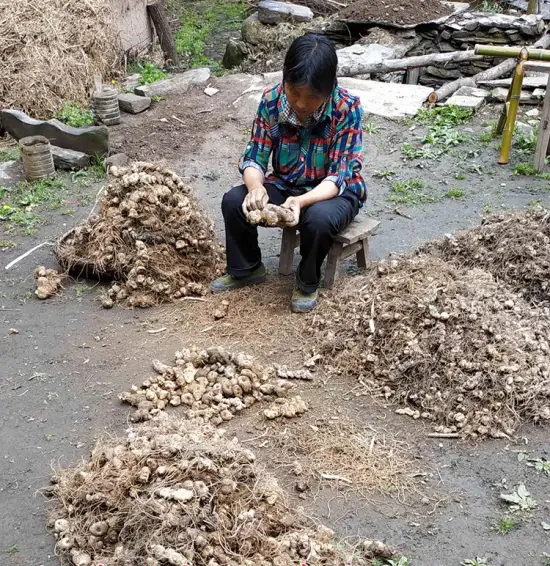
The Forest Association report is grim. Of the 37,000 registered herbalists in China, over sixty percent are over sixty years old. The young people have gone to the cities. Last year, I took a boy from the next village up the trail. He saw the cliff face and his legs buckled. “Brother Zhang, can’t we just use a drone and a net? Why risk your neck?”
I ran my fingers over the ancient rope grooves carved into the rock face by my ancestors. Those grooves are deeper than any family genealogy book. “The mountain is getting thin,” Grandfather rasped on his deathbed, eyes fixed on the empty basket hanging from the rafter like a coffin. “Thin.”Wild Solomon’s Seal
He was right. The ancient Huangjing with golden veins in its leaves—the ones that whisper of thirty years of silent growth—are now almost legend. The forest has been combed over like a miser’s scalp. What remains is bone and stone. Yet here I am. Thirty-eight years old, with a face weathered like sixty, silver already threading my temples.
A Vanishing Breed

Tonight, by the crackling fire, I look at the haul in my basket. The smooth Huangjing rhizomes. The black sclerotia of Zhuling. The dark juice of Hanliancao staining the bamboo. This basket will patch the leak in the roof. It will buy my mother the thick cotton shoes she refuses to buy for herself. It will fill the gaps that never stay filled. Tomorrow, I will wake before dawn. I will carry the mountain’s dwindling gift to the town market. The mountain grows thinner. The cliffs grow steeper. But as long as the golden veins still pulse in the deep shade, I will walk into the mist.
Research from the Wuhan Botanical Garden of the Chinese Academy of Sciences confirms that Polygonatum (Huang Jing) is exceptionally rich in bioactive compounds with significant nutritional and medicinal value. According to their systematic study published in Molecular Phylogenetics and Evolution, the rhizomes of Polygonatum sibiricum, Polygonatum cyrtonema, and Polygonatum kingianum are abundant in non‑starch polysaccharides,
oligosaccharides, saponins, and flavonoids—all of which contribute to the plant’s powerful therapeutic profile. These active constituents have been demonstrated to exhibit antioxidant, anti‑inflammatory, immune‑enhancing, glucose‑regulating, and lipid‑lowering properties. This research provides a robust scientific foundation for understanding why Polygonatum has been treasured for centuries as a premier tonic herb in traditional Chinese medicine, and why modern consumers increasingly seek it out as a high‑value functional food.

