
Video Description: Harvesting 50-Year Wood-Fired Furnace Soil
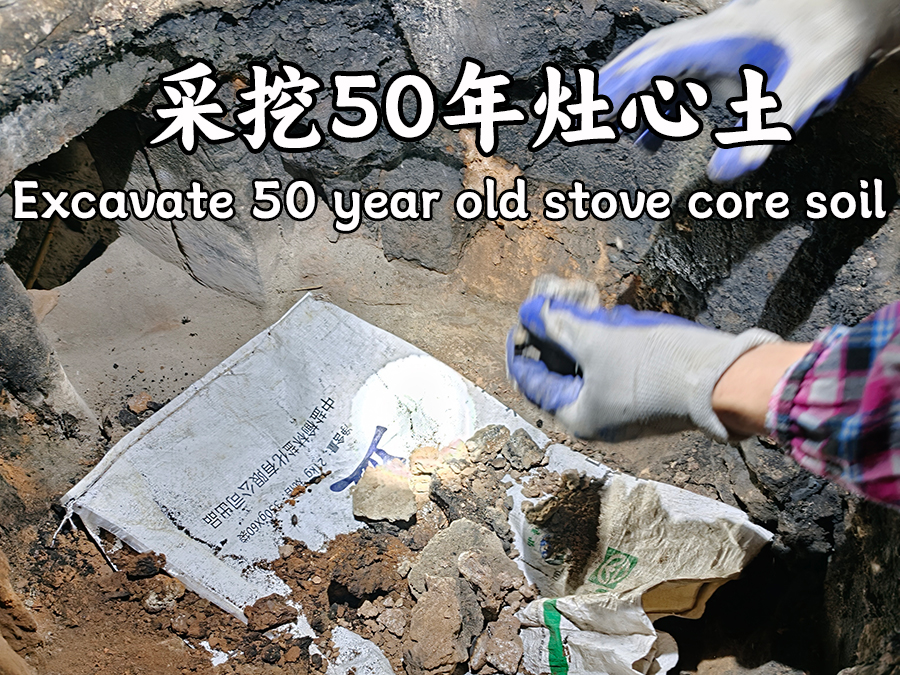
The accompanying video documentation captures the careful extraction of this rare, half-century-old Furnace Soil (Zao Xin Tu) directly from the original traditional stove site. Viewers can observe the dense, layered texture of the pure yellow clay that has been naturally baked by decades of continuous wood fires. The footage highlights the distinct color transformation from raw yellow earth to the deep, rich hue characteristic of authentic Fulonggan. This visual record underscores the material’s absolute purity—visibly free from coal ash, plastic residue, or chemical additives—and preserves the memory of a functional agrarian hearth that served a household daily for fifty years.
Fifty-Year Furnace Soil: A Legacy of Fire, Earth, and Time
In a quiet corner of the countryside, nestled within the heart of a traditional earthen stove that has seen half a century of daily use, lies a treasure that cannot be manufactured in any factory or replicated by modern chemistry. This is Furnace Soil (Zao Xin Tu)—a medicinal clay forged not in hours or days, but over fifty years of patient, uninterrupted wood-fire cooking.
This is not ordinary dirt scooped from the ground. It is the very core of the stove’s lining: the yellow clay heart that has absorbed the warmth and essence of countless meals. For five decades, this old stove has been lit three meals a day, every day, fueled exclusively by pure, natural firewood. There have been no shortcuts, no artificial heat sources. The fire has been tended, the flames have danced, and the clay has quietly listened.
This unique substance, known in traditional Chinese pharmacology as Furnace Soil, is often compared to Terra Flavausta in historical Latin texts. Its properties are distinct from ordinary earthen materials due to the decades of wood smoke absorption.
How Furnace Soil is Formed: The Slow Alchemy of Fire and Earth
What sets this Furnace Soil apart from any industrially processed material is its absolute purity and the profound slowness of its creation. In an age of mass production, where bricks are fired in kilns within hours using coal or gas, this clay has undergone a fundamentally different transformation. It is the product of “slow firing”—a gentle, cumulative baking that spans generations.
Crucially, this process has been completely free of plastic, coal, or any chemical additives. Modern stoves often burn trash, plastic wrappers, or treated wood, which would irreversibly contaminate the clay with toxic residues. This old stove, however, has only ever known the clean burn of hardwood, branches, and dried grasses harvested from the surrounding hills. There has been no coal smoke, no synthetic fumes—only the pure, aromatic breath of natural timber turning to ash.
Because of this, the Furnace Soil has absorbed nothing but the beneficial trace elements found in plant ash and the “yang energy” of the wood fire—a concept deeply rooted in traditional understanding. Over fifty years of gentle, sustained heat, the original soft yellow clay has undergone a slow metamorphosis. The heat and smoke have penetrated deep into its matrix, gradually transforming it into a dense, structurally sound material with a deep, rich coloration. This is the true “Fulonggan” (Hidden Dragon’s Liver) , a name that speaks to its mythical status in traditional herbalism.
A Scarce and Priceless Heritage
Every single gram of this Furnace Soil is imbued with the wisdom of a bygone agrarian era. It carries the unmistakable, earthy fragrance of wood smoke—a scent that cannot be synthesized in a laboratory. It is a physical record of half a century of daily life: the boiling of water, the simmering of stews, the warmth of the hearth on cold winter mornings.
The scarcity of such material today cannot be overstated. Rural depopulation, the shift to modern gas or electric cooktops, and the simple fact that a stove must be used continuously for decades make authentic, aged Furnace Soil exceedingly rare. It is not a commodity that can be ordered in bulk; it is a legacy material, passed down through the very walls of the family kitchen.
Whether intended for traditional preparations, as a unique cultural artifact, or as a specific medium for practices that value its purity and elemental connection to fire and earth, this fifty-year-old yellow clay Furnace Soil offers something no modern alternative can: authenticity, purity, and the weight of time itself. It stands as a quiet monument to a way of life where the hearth was the center of the home, and where the simplest elements—earth, fire, and patience—could create something truly remarkable.
This rare Furnace Soil is now carefully harvested from the original stove site, preserving its integrity for those who understand and appreciate its unique value.
The Value of Slow Time in a Fast World
In an era dominated by instant gratification and industrial efficiency, the story of this fifty-year Furnace Soil offers a quiet but profound counter-narrative. It reminds us that certain things cannot be rushed. The transformation of ordinary yellow clay into therapeutically valued Zao Xin Tu is not merely a chemical process—it is a testament to patience, continuity, and the accumulated care of generations. Each meal cooked upon this stove, each bundle of firewood added to the flames,
and each wisp of smoke that curled through the hearth contributed an invisible layer to the clay’s character. There is no laboratory shortcut to replicate half a century of gentle, wood-fired warmth. This is the irreplaceable value of what has been termed “slow creation” in traditional craft—where time itself becomes an essential ingredient. To hold a piece of this Furnace Soil is to hold a fragment of living history, a tangible connection to a rhythm of life that is rapidly fading from the modern world.